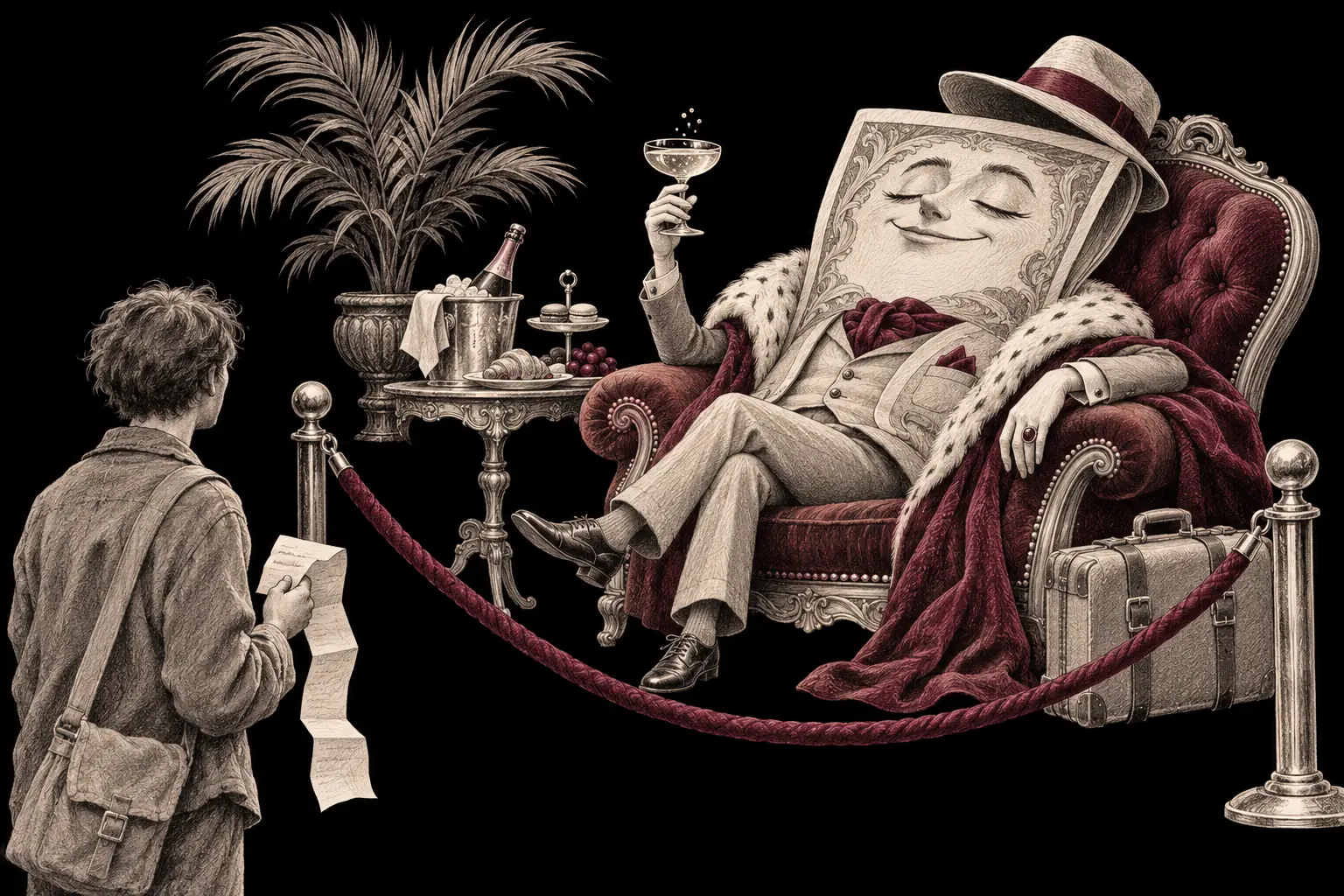
Your money is doing fine.
It found a promising company, survived its previous owner’s bankruptcy and met some very influential people.
It now has artificial intelligence, excellent prospects and a stock-market debut.
You have a claim reference number.
Don’t be jealous. Everyone builds a career however they can.
In 2021, FTX invested $500 million in Anthropic, the company that would later give the world Claude. The initial stake was roughly 13.6%; subsequent funding rounds diluted it.[1]
If the name FTX gives you a faint feeling that some money has gone missing again, your memory is working perfectly.
The exchange went bankrupt in November 2022. Customers lost access to their accounts. Its founder, Sam Bankman-Fried, was subsequently convicted of stealing billions in customer funds.[1]
And in the middle of the wreckage sat an investment that turned out exceptionally well.
So well, in fact, that it can now be considered separately from his other managerial achievements.
Sometimes the investment instinct really is there. It’s the permission to use other people’s money that needs work.
After FTX collapsed, adulthood arrived.
No presentations about the future of finance. Lawyers, a court, lists of assets and the question of what could be sold to repay creditors.
In February 2024, a judge approved the sale of the Anthropic shares. Some customers had objected, arguing that the stake had been bought with embezzled customer money. They eventually allowed the sale to proceed while retaining the ability to argue over their rights to its proceeds.[1]
The documents used restrained language: share sale, procedure, purchasers, objections.[2]
Financial law has a remarkable gift for describing the worst year of your life as though someone were rearranging the office furniture.
In 2024, the stake was sold to several groups of buyers for approximately $1.3 billion. The original investment had been $500 million. The sale therefore recovered substantially more than had been spent.[3]
That could have been the full stop.
But Anthropic kept getting more valuable.
And the full stop became a very expensive ellipsis.
On 19 November 2026, Forbes published calculations of the value of stakes acquired in the FTX sale, using Anthropic’s opening share price.
An investment vehicle linked to Mubadala bought nearly $500 million in shares. Forbes estimated that stake could now be worth around $18.6 billion.
G Squared invested approximately $135 million; its stake’s estimated value reached around $5 billion.
Jane Street bought approximately $100 million in shares; their estimated value rose to around $3.7 billion.[4]
This does not mean those sums are already sitting in someone’s bank account. Forbes calculated market values on the assumption that the buyers had retained the shares.
But even on paper, it’s a pleasant result.
Especially if your recent financial experience hasn’t consisted of refreshing a page labelled “Claim status”.
And here’s a detail for anyone who enjoys a slightly overenthusiastic screenwriter: Jane Street is Bankman-Fried’s former employer.[4]
High finance is a small world.
Sometimes your lost luggage ends up with people who knew the pilot before the crash.
At this point, it’s tempting to write a simple, furious story.
Nothing for customers. Everything for big funds. Curtain, applause, scheduled hatred of capitalism.
But customers did receive repayments.
In July 2026, FTX announced another distribution of approximately $900 million. For two main customer classes, cumulative distributions were scheduled to reach 105% of allowed claims; for the small-claims category, 120%, subject to the required conditions.[5]
At first glance, more than was taken.
Time to order the balloons marked “Financial justice”.
First, though, it helps to establish what the percentage is a percentage of.
Customer claims were valued in dollars using cryptocurrency prices at the time of the November 2022 bankruptcy. Repaying that amount did not mean returning the same number of coins at their later market value.[1]
Imagine being owed an apartment but receiving its valuation on the date someone took away your keys.
With interest.
Meanwhile, the apartment has been enjoying a lovely market of its own.
That isn’t an exact description of FTX’s legal arrangements. It explains why “you received more than a hundred per cent” can sound considerably more festive than it feels.
A percentage is a wonderful thing. Especially when nobody specifies which past it’s calculated from.
Does this mean the administrators should definitely have held the Anthropic shares until now?
No.
In 2024, the future share price wasn’t sitting in the folder beside the sale agreement. There were creditors to repay and a risk that the asset could lose value.
Liquidating a company is not an investment club governed by “hang on, everyone, I think this one’s about to take off”.
The buyers took risks too. Their future returns were not guaranteed.
But this is where the story becomes more interesting than straightforward outrage.
Some people needed their money back.
Others had the money to buy the option of waiting.
The textbook calls these different investment horizons.
In real life, some people have rent due on the first. Others have a long-term strategy committee.
We love stories about patient investors.
They don’t panic. They look ahead. They recognise potential. They buy when everyone else is frightened.
It sounds like a list of virtues.
Less often mentioned: patience needs funding.
Waiting is much easier when you don’t need the money you’re waiting for to live on.
You can weather a falling valuation. Turn down a poor offer. Say: “We believe in the long-term outlook.”
Try that on your dentist.
There’s another temptation here: deciding that Anthropic’s success somehow vindicates Bankman-Fried.
Look, the man could see the future.
But a successful investment doesn’t retrospectively create permission to use other people’s funds.
If someone takes your car without asking and wins a race in it, the trophy is not a substitute for consent.
Although it would certainly improve the investor presentation.
We don’t have to choose between two fairy tales: the misunderstood genius, or the buyers who must somehow have robbed someone.
Just watch the same investment pass through different hands.
For some, it’s part of a bankruptcy case.
For others, it’s one of their best purchases.
And here we are, back at artificial intelligence.
A technology that promises to make opportunity more accessible.
In this particular story, access to opportunity was quite tangible: you needed money to buy the shares being sold, and the ability to keep holding them.
Using Claude and owning part of the company that makes it are two very different ways of participating in the future.
The first helps you write a letter about your financial difficulties.
The second, if things go well, makes those letters unnecessary.
So the most interesting part isn’t even what the shares were worth on their first trading day.
It’s who could afford to stay in the story long enough.
The sale proceeds entered the repayment process. The shares went to new owners. The subsequent appreciation went with the shares.
You can account for it all in the paperwork.
And still be left with that unpleasant feeling: a future you had some connection to happened without you.
Your money really may have found its way into a promising story.
The invitation to the happy ending simply went to a different owner.